
Operating and Maintaining a High-Speed Clamshell Labeling Line
High-speed clamshell labeling involves more than applying a label accurately. Containers have to be denested, labeled, and restacked while maintaining the throughput required by the production line.
The AB Technology Label Line brings those steps together in one continuous process for clamshell and pocketed containers. For engineers responsible for specifying, integrating, or maintaining this type of equipment, performance depends on more than maximum machine speed.
Throughput, container size, changeovers, maintenance access, controls, safety, and surrounding equipment all need to be considered when determining how the labeling system will perform in production.
What Determines Clamshell Labeling Line Throughput?
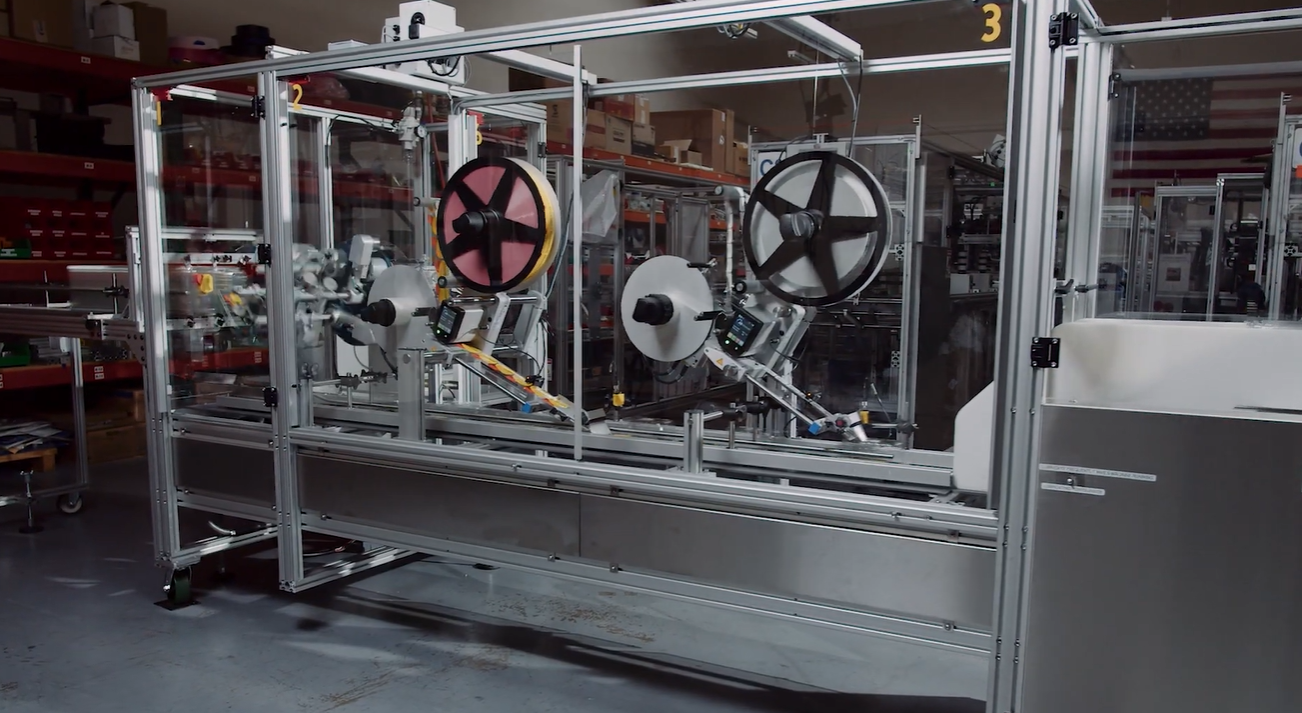
The AB Technology Label Line operates at speeds up to 200 parts per minute for standard clamshells and approximately 160–170 containers per minute for larger shapes.
Those figures provide a useful benchmark, but actual production speed depends on the application. Container size and geometry, label material and adhesive, upstream and downstream conditions, top and bottom labeling requirements, and the overall line configuration can all affect performance.
The Label Line uses a continuous rotary design intended to provide consistent, accurate label placement. Its dual-applicator configuration uses Cab IXOR labelers for top and bottom label application, allowing both labels to be applied within the same system.
For applications requiring both branded and UPC labels, that means the two labeling operations can be completed in one continuous process.
For a closer look at high-speed clamshell labeling applications, see How Automation Solved the Strawberry Clamshell Labeling Bottleneck.
What Should Engineers Evaluate Beyond Rated Speed?
Rated throughput is only one part of equipment evaluation. Engineers also need to consider how the machine will be operated, adjusted, monitored, and serviced during production.
The Label Line uses a modular, open-frame design that provides full-length visibility and access across the machine. Operators can monitor the system through a centralized HMI that provides speed adjustments, fault alerts, and diagnostics.
Full guarding and interlock safety switches enclose the operating area.
For facilities running multiple container formats, the system is also designed for no-tool changeovers between supported clamshell sizes. This reduces the need for additional tooling when moving between approved formats.
The Label Line supports clamshell sizes from 4 oz to 18 oz, with application requirements reviewed according to the container and production process.
What Maintenance Does a High-Speed Labeling Line Require?
The AB Technology Label Line is built for round-the-clock operation with minimal maintenance requirements.
Routine maintenance is based around intermittent lubrication and accessible service points. Its open-frame construction also gives maintenance personnel visibility and access along the machine.
AB Technology specifies components rated for 10–20 years, supporting the system's focus on long-term continuous operation.
A practical maintenance program may include:
Inspection and cleaning of the denester, upstacker, labeling areas, and label applicators
Checks of guarding and interlock switches, HMI fault alerts and diagnostics, and lubrication at the intervals specified for the installed machine
The appropriate inspection frequency should ultimately be established around the operating conditions and maintenance requirements of the installed system.
What Should Be Planned Before Installation?
The Label Line's compact, mobile, modular design is intended to simplify integration into existing production environments. However, engineers should still evaluate how the machine will fit within the overall process before installation.
Space and service access are an important part of that evaluation. The equipment layout should provide adequate room for operation while preserving the visibility and access provided by the Label Line's open-frame construction.
Upstream and downstream conditions should also be considered. Actual machine performance can depend on the equipment and processes surrounding the Label Line, so rated speed should not be treated as an isolated measure of total line capacity.
Container requirements are another part of the equation. The Label Line is designed for thermoformed packaging, including clamshell and pocketed containers, with a standard clamshell size range of 4 oz to 18 oz. Container format and labeling requirements should be reviewed as part of the application before determining the final configuration.
How Are Different Clamshell Sizes Changed Over?
Changeover requirements become increasingly important in facilities running multiple container formats.
The AB Technology Label Line uses a modular architecture designed for no-tool changeovers between supported clamshell sizes.
For engineering and operations teams, repeatability is still important. Approved settings and procedures should be documented so operators can consistently return the machine to the appropriate configuration when changing products.
When introducing a new container, engineers should consider its size and geometry, top and bottom labeling requirements, label material and adhesive, and required production rate. These variables can influence the final application and expected performance.
What Should Engineers Monitor During Production?
Maximum machine speed does not provide a complete picture of production performance.
The Label Line's centralized HMI provides speed adjustments, fault alerts, and diagnostics, giving operators and maintenance teams a central point for monitoring machine operation.
Beyond machine speed, sustained containers per minute, label placement consistency, waste and rework, changeover duration, unplanned downtime, fault history, and operator interventions can all provide useful insight into how the system is performing.
These operational measures are not machine specifications, but they can help engineering teams evaluate whether the labeling process is consistently meeting the facility's production requirements. Recurring fault information can also provide a useful starting point when investigating interruptions.
Can Labeling and Padding Be Combined?
Yes.
For applications requiring both labeling and absorbent-pad insertion, AB Technology offers a Combo Line that combines labeling and padding on one modular platform.
The system is designed as a continuous solution for foods, fruits, and proteins across a variety of clamshells, containers, and trays.
AB's separate Pad Line automates denesting, glue application, absorbent-pad insertion, and restacking. Depending on the application, padding can therefore be handled as a dedicated operation or combined with labeling.
Engineers considering whether to consolidate these processes can also read Why Combo Labeling & Padding Machines Improve Thermoform Packaging Efficiency.
How Does the Label Line Fit Into a Larger Packaging System?
The performance of a labeling machine also depends on how it fits into the surrounding production process.
AB Technology specializes in thermoformed packaging automation, including labeling, padding, combination labeling and padding systems, and custom packaging automation.
As part of the Excelis family of companies, AB Technology can also support applications where thermoformed packaging automation needs to coordinate with filling, capping, material handling, or secondary packaging equipment.
For engineers planning a larger automation project, this provides an opportunity to evaluate labeling as part of the overall packaging line rather than as an independent operation.
What Should Engineers Consider When Evaluating the Line?
A high-speed labeling system should ultimately be evaluated against the requirements of the actual production environment.
For the AB Technology Label Line, the primary technical considerations include:
Performance and container handling: 4 oz to 18 oz clamshells; up to 200 PPM for standard clamshells and approximately 160–170 CPM for larger shapes; proprietary denester and upstacker platform; dual top and bottom Cab IXOR label applicators
Machine design and operation: Continuous rotary, modular open-frame construction; centralized HMI with speed adjustment, fault alerts, and diagnostics; full guarding and interlock safety switches; no-tool changeovers; intermittent lubrication and accessible service points; combined labeling and padding available through the Combo Line
Those specifications provide the starting point. The final evaluation should then consider how the machine's capabilities align with the facility's containers, labels, required production rate, and surrounding equipment.
AB Technology has more than 30 years of packaging automation experience and provides U.S.-based service, parts, and technical support from its team in Red Wing, Minnesota.
Learn more about AB's approach to thermoformed packaging automation in The Story Behind AB Technology.
Talk Through Your Application
Every application has its own container, label, throughput, and line requirements.
Share your container sizes, label requirements, target production rate, and current process with the AB Technology team to discuss how the Label Line could be configured for your operation.